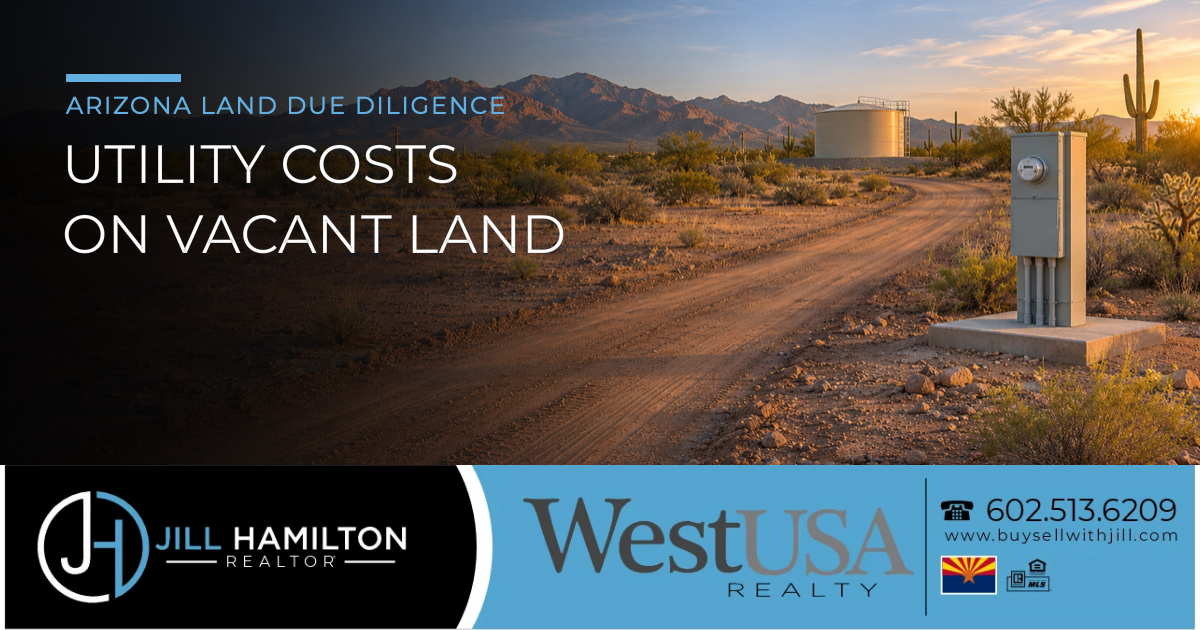
The Real Cost of Utilities on Vacant Arizona Land
A vacant Arizona parcel can look like a bargain until the buyer asks one essential question: What will it actually cost to make this land usable?
The listing price is only the opening number. Power, water, wastewater, access, grading and permits can change the economics of a parcel dramatically. A utility line visible across the road does not guarantee service to the property. A neighboring well does not guarantee that another well can be drilled successfully. “Septic required” does not mean the lot will support the system a buyer needs.
The goal of land due diligence is to replace every convenient assumption with written information.
Start with the intended use
Utility research should begin with what the buyer plans to do. A weekend recreational parcel has different requirements from a full-time residence, manufactured home, agricultural operation, workshop or future subdivision.
Define the intended structures, approximate size, water demand, electrical load, access needs and development timeline. Then ask the county, municipality, utility providers and qualified contractors whether that plan appears feasible. Zoning alone is not approval to build, and a parcel can be legally usable for one purpose but impractical for another.
Power at the road may still be expensive
Buyers often see poles or lines near a parcel and assume electricity will be simple. The utility must confirm the service territory, point of connection, available capacity and requirements for extending service.
Depending on the property, costs may include engineering, poles, trenching, conduit, transformers, meters, easements and restoration of roads or neighboring land. The customer may be responsible for some or most of a line extension, and utility tariffs or policies can affect the calculation.
Ask for a written estimate or formal process—not a casual statement that “power is close.” Confirm how long the estimate is valid, what work the buyer must provide and whether the estimate includes every step needed to energize the property.
Off-grid solar can be a practical alternative, but it also requires a complete design. Consider battery storage, backup power, well-pump demand, heating and cooling, maintenance and replacement costs. “Going solar” is not a substitute for calculating the actual load.
Water requires more than a blue line on a map
If a water provider serves the area, verify whether a meter is available for the specific parcel, whether capacity exists, and what fees or extensions are required. Ask about water quality, monthly charges and any restrictions that could affect the intended use.
If the property will rely on a private well, investigate local drilling history, depth, production, water quality and permitting. Obtain guidance from qualified well professionals. No one can promise that a new well will match a neighbor’s performance.
Hauling water may work for certain uses, but buyers should calculate storage, delivery access, recurring cost and reliability. A low initial setup cost can create a permanent operational burden.
Wastewater can determine whether the lot works
Land outside a sewer service area may require an onsite wastewater system. The buyer should investigate soil conditions, site evaluation requirements, setbacks, topography and the size of system needed for the planned structure.
A parcel can be large and still have limited usable area because of washes, easements, flood hazards, steep slopes, wells, property-line setbacks or unsuitable soil. A conventional system may not be feasible, and an alternative design can cost more.
Do not assume that a neighboring septic system proves feasibility. Conditions can change across short distances, and current rules may differ from those in effect when the neighbor built.
Access is part of the utility plan
Legal access and physical access are not the same. A recorded easement may exist, but the route may require grading, drainage work or permission for utility installation. Conversely, a visible dirt road may cross private property without adequate legal rights.
Confirm who maintains the road, whether emergency and construction vehicles can reach the site, and whether utility companies have the easements they need. If heavy equipment cannot reach the parcel, even a feasible utility plan can become far more expensive.
Ask for written answers and real bids
A useful due-diligence file should include provider maps, written availability responses, preliminary estimates, easement documents, well or septic research, contractor input and notes from the permitting authority. Date every item and record whom you spoke with.
For major costs, obtain more than one bid when possible. Make sure the bids use the same scope. One contractor may quote only trenching while another includes conduit, equipment and restoration, producing numbers that look comparable but are not.
Add a contingency for changes. Rural development can uncover rock, drainage, distance or equipment issues that were not visible during a desktop review.
Let the contract protect the investigation
The purchase contract should provide enough time and access for the buyer to complete the necessary research. Due-diligence deadlines matter. If the intended use depends on a particular utility, permit or access condition, discuss how that requirement should be addressed before signing.
Real-estate agents can coordinate the investigation, but they do not replace engineers, surveyors, utility providers, well contractors, septic professionals, land-use planners or attorneys. The best land purchase is built on a team of appropriate experts.
Calculate the finished-site number
Before deciding whether the parcel is a bargain, build a simple development budget:
• purchase price and closing costs; • survey, engineering and permitting; • power, water and wastewater; • legal and physical access; • clearing, grading and drainage; • site preparation and foundations; • carrying costs and a contingency reserve.
Compare parcels using the projected cost of a usable site, not just the price per acre. A more expensive parcel with confirmed utilities and access may be the better investment. A cheaper parcel can still be right—but only when the buyer understands the work and risk.
Vacant land rewards patience. The view may sell the dream, but written utility answers determine whether the dream can be built.
CTA: Considering Arizona land? Jill Hamilton can help you organize the questions, documents and specialists needed to evaluate the parcel before your due-diligence window closes.
Compliance footer: Jill Hamilton, REALTOR®, CLHMS, RENE | West USA Realty, Luxury Division | 1850 E. Northrop Blvd., Suite 170, Chandler, AZ 85286 | 602-513-6209. Equal Housing Opportunity. Information is deemed reliable but not guaranteed and is not legal, engineering, utility, environmental, zoning or tax advice. Buyers should independently verify all information with the applicable authorities and licensed professionals.
